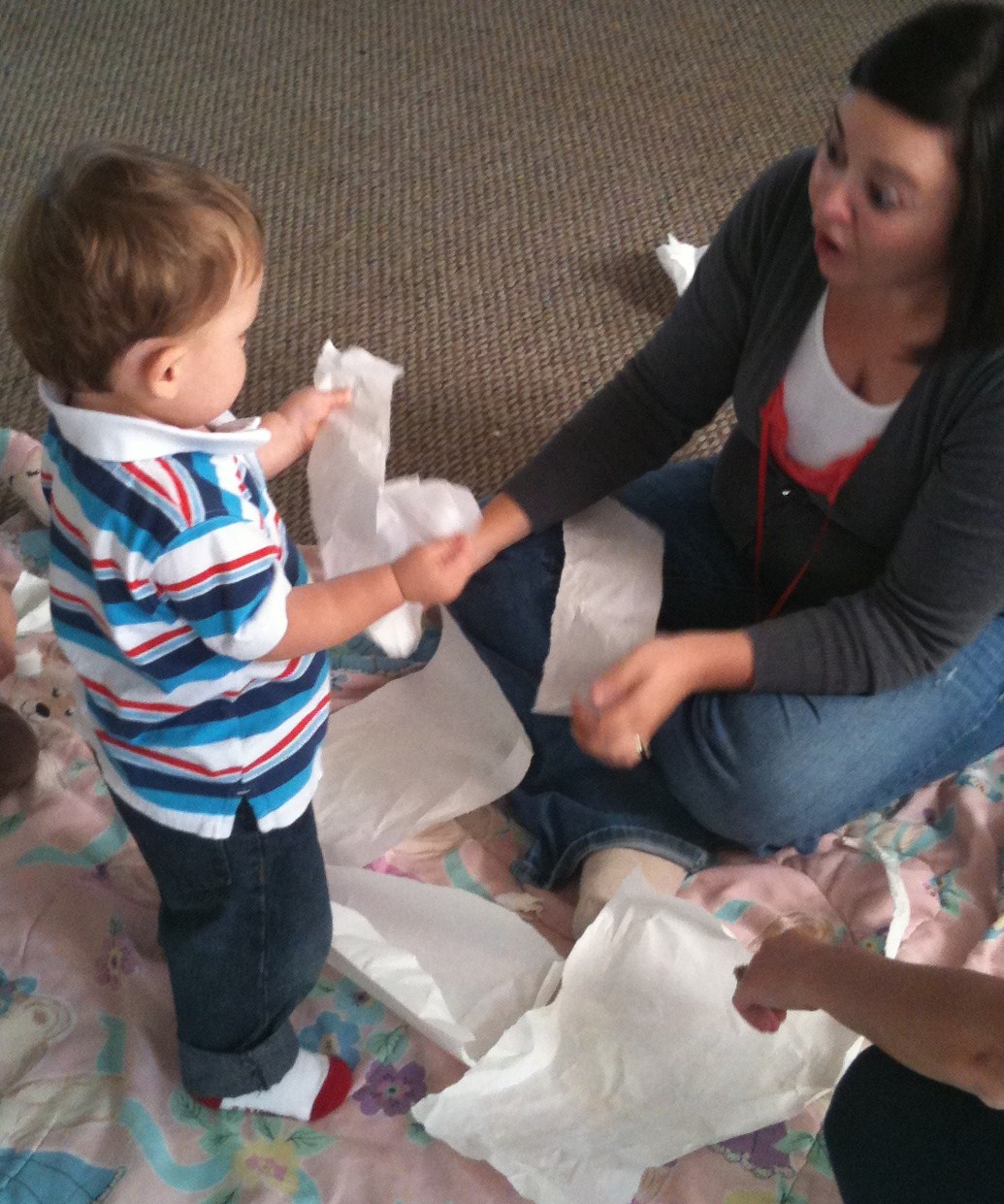
Egg-shaking fun!
Thursday, October 27, 2011
Week 7
Week 7
Friday, October 21, 2011
Week 6
“Not every child understands from the same learning approach. There are several different approaches for each child. It’s finding the way to teach the material to the child that’s key…” (Score! Making the Grade: Grades 1-2, by the Staff of Score!, p. 15.)*
Each week, each Kindermusik class offered a diverse array of musical experiences—from aurally identifying instruments to playing instruments on a musical cue, from listening to sounds of nature to visually recognizing a new music notation symbol, and from singing songs to playing movement games. Through various learning modes, several musical concepts are introduced and learned. Each Kindermusik classroom is likely to include children with different learning styles. For example, some children learn best when a concept is introduced visually, some through aural introduction, and some through movement. Each and every Kindermusik class incorporates several learning modes, making learning accessible to each and every child!


Each week, each Kindermusik class offered a diverse array of musical experiences—from aurally identifying instruments to playing instruments on a musical cue, from listening to sounds of nature to visually recognizing a new music notation symbol, and from singing songs to playing movement games. Through various learning modes, several musical concepts are introduced and learned. Each Kindermusik classroom is likely to include children with different learning styles. For example, some children learn best when a concept is introduced visually, some through aural introduction, and some through movement. Each and every Kindermusik class incorporates several learning modes, making learning accessible to each and every child!
Monday, October 10, 2011
Week 5
Family Time: Movin’ & Groovin
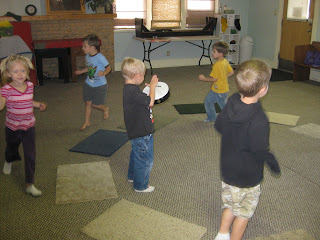
The movement focus for Lessons 5 and 6 is pathways. Our world is most commonly organized in straight lines, emphasizing efficiency and directness. When children have the opportunity to explore lots of different ways to get from one place to another, they enhance their awareness of the world around them, and develop increased agility. When a child creates curves and zigzags with her arms and upper body, she frequently crosses the midline, helping to strengthen her corpus callosum and the ability of the brain’s two hemispheres to communicate with each other. When we explore the space we have around us, we can create new pathways—curved, circular lines; sharp, angular, zigzag lines; straight lines, forward and back, side to side, and all sorts of combinations.
Like other elements of movement, pathways help develop coordination and balance. We created pathways through large muscle movements by walking/running/hopping along the ground. We then created pathways with our fine motor skills and some crayons! Instruments work too!

The movement focus for Lessons 5 and 6 is pathways. Our world is most commonly organized in straight lines, emphasizing efficiency and directness. When children have the opportunity to explore lots of different ways to get from one place to another, they enhance their awareness of the world around them, and develop increased agility. When a child creates curves and zigzags with her arms and upper body, she frequently crosses the midline, helping to strengthen her corpus callosum and the ability of the brain’s two hemispheres to communicate with each other. When we explore the space we have around us, we can create new pathways—curved, circular lines; sharp, angular, zigzag lines; straight lines, forward and back, side to side, and all sorts of combinations.
Like other elements of movement, pathways help develop coordination and balance. We created pathways through large muscle movements by walking/running/hopping along the ground. We then created pathways with our fine motor skills and some crayons! Instruments work too!
Thursday, October 6, 2011
Week 4
Children learn through play. Through manipulation of objects, they learn about the world around them. Each child will have his own “action schemes” or ways of manipulating objects. Observe some of the following schemes: mouthing, shaking, throwing, dropping, hitting, slapping, and reaching.
Subscribe to:
Posts (Atom)